I'm reading the debut works of 100 famous authors.
First up: Alice's Adventures in Wonderland. Just finished it.
"Oh, that old fairy-tale classic, right?"
Yeah. But the first thing I thought after reading it was: this is a scary book. Not scary like horror. Scary in a technical sense.
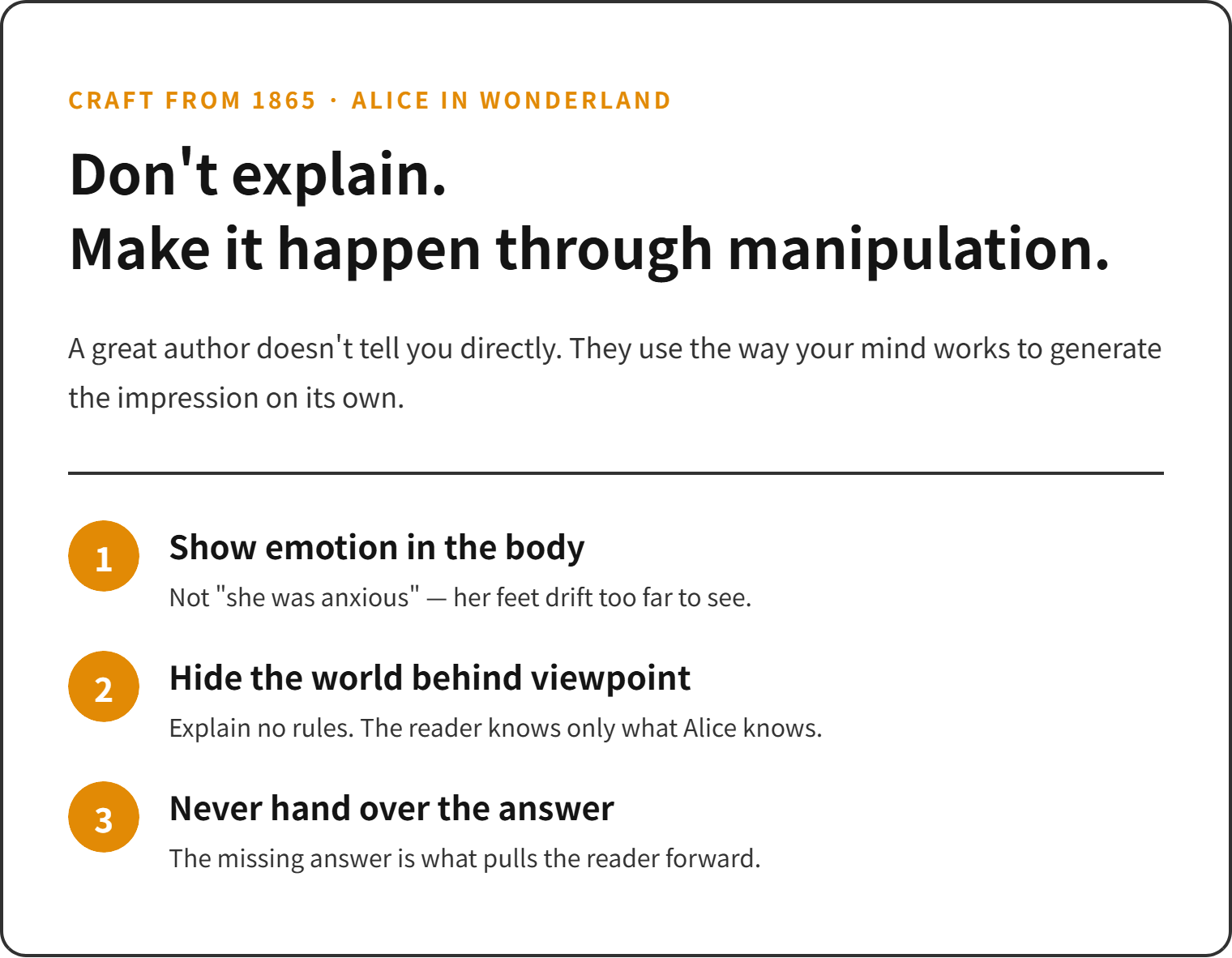
This thing was written in 1865. And yet it does almost everything the modern "how to write fiction" textbooks tell you to do.
Never state emotion directly.
Never explain the world.
Never hand over the answer in dialogue.
This isn't an accident. Lewis Carroll engineered these devices on purpose.
Today I'm dissecting three of them. With a training drill at the end so you can actually steal these moves.
1. Never hand over the answer in dialogue
There's a scene where Alice reaches a fork in the road and asks the Cheshire Cat which way she should go.
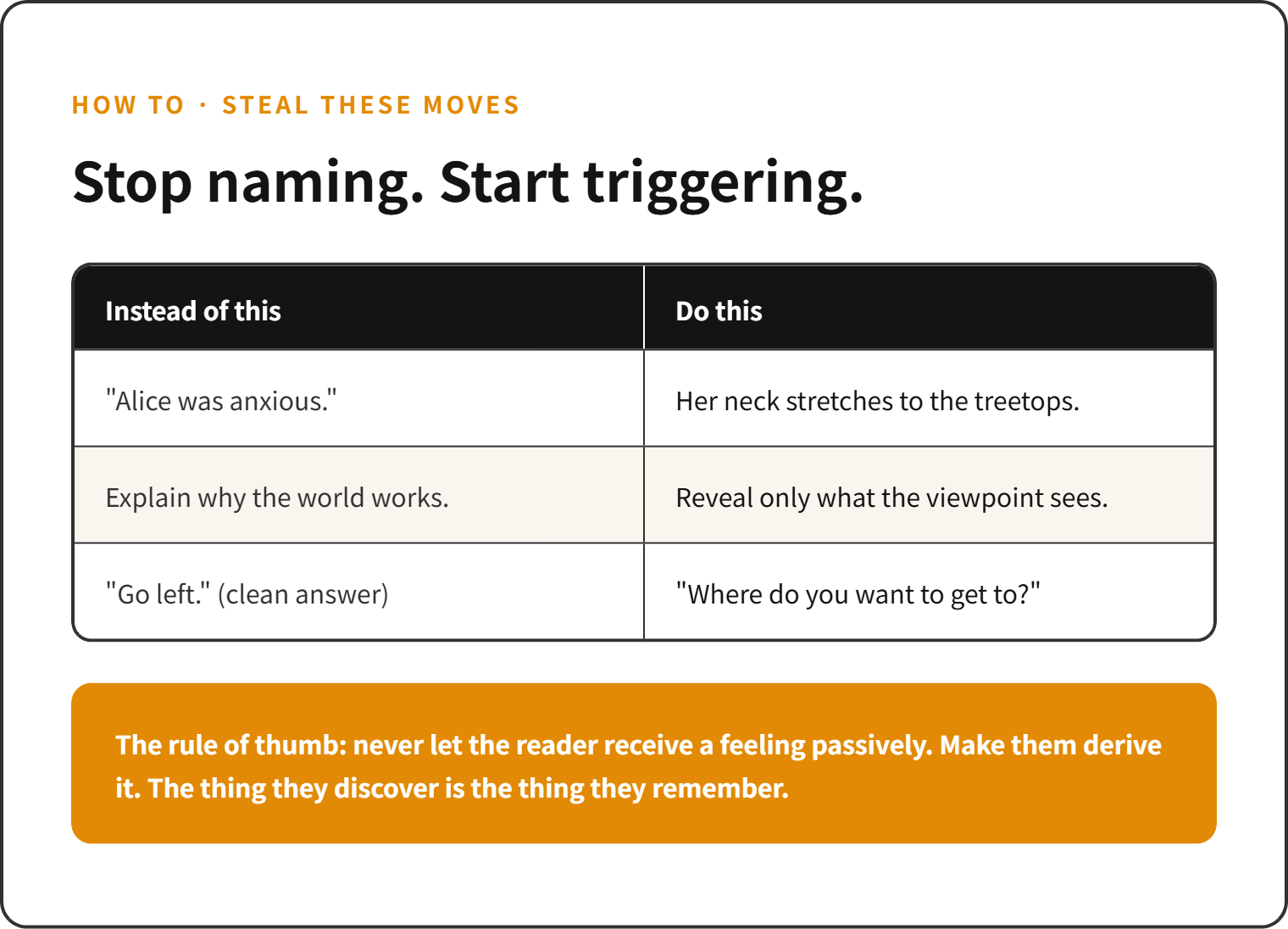
In a normal story, you'd get "go right" or "go left." But the Cat replies: "Where do you want to get to?"
When Alice says she doesn't much care, the Cat says then it doesn't matter which way she goes.
Kind of a smart-aleck, right?
Logically flawless. Practically, it solves nothing.
And it's not a one-off. Carroll does this in nearly every conversation in the book. He never lets a character answer directly.
Dodge the point.
Ask a question back.
Demolish the premise itself.
Change the subject.
It's always one of those four.
Why does this work? It comes down to reader psychology.
The second we see a question, our brain expects an answer. When it doesn't come, the curiosity never resolves. We read on, left dangling. And because we share Alice's "wait, what?" feeling, we bond with her too.
That's three birds with one stone.
Where it fails: when the dodge has no wit behind it. The moment readers sense "the author just hasn't figured out the answer," it's over. The Cat's reply has its own internal logic. That's why it reads as cleverness, not laziness.
The structure looks like this:
- Have one side ask a clear question (reader expects an answer)
- Have the other side avoid answering directly (dodge, reverse-question, or deny the premise)
- The avoidance makes the asker reveal new info or assumptions
- Use that assumption to void or suspend the original question
- Slide the conversation to the next topic, answer still hanging
2. Make the body speak the emotion
The sentence "Alice was anxious" never appears in this book.
What appears instead is the body.
Drink something, grow huge.
Eat something, shrink.
Neck stretches up above the trees.
Feet so far away she can't see them.
At one point Alice wonders whether she's even the same person she was that morning. Collapse of identity. Loss of self. But Carroll never uses those words. He shows it from the outside, as the physical event of a body coming apart.
Why does this hit harder?
The word "anxious" gets processed in the head. It just passes through as a concept.
But "my feet are drifting away" gets processed in the body. Our own bodies twitch a little as we read.
Name the emotion and we receive it passively. But derive the emotion ourselves from a bodily glitch, and that emotion becomes our discovery.
The moment you go "oh, this is a metaphor for losing yourself" is the moment empathy fires.
The beginner mistake: tacking "in other words, she was anxious" right after the bodily description. That zeroes out the whole effect. It destroys every bit of space the reader had to figure it out themselves.
The structure:
- Pick one abstract emotion you want to convey (e.g. loss of self)
- Map it onto a physical state (loss of self → loss of bodily control, boundaries dissolving)
- Describe only the bodily event, no emotion words
- Have the character show confusion at that state through action
- Let the reader retroactively cash the bodily glitch in as a metaphor for the emotion
3. Lock the viewpoint to Alice's perception
This book never once explains how Wonderland works.
Why are the playing cards alive. Why has time stopped. Why is the Queen obsessed with chopping off heads.
No explanation. None of it.
In the rabbit-hole scene, Alice sees shelves and jars as she falls, but she keeps falling without ever knowing what they are. Only when she lands does she face the new situation.
We're in the same spot. We see only what Alice sees. What Alice doesn't understand, we don't either. The information matches exactly.
Why does that matter? It's about where the reader stands.
When the reader knows more than the protagonist, they get to sit in the "safe spectator seat." You can predict "ah, that's a setup" or "this character dies later." Comfortable, but no immersion.
When the information matches, the reader is forced into the same defenseless place as Alice. The dread of not seeing what's coming, plus the curiosity about what's next, both stay switched on the whole time.
Because nothing is explained, the world keeps its mystery and its pull.
The mystery never gets consumed cheaply.
Two ways this fails. One: you have a world you want to show off, so you leak explanation through the narration. Two: you lock it down so hard the reader can't grasp anything and bails. It takes balance.
The structure:
- Pick one viewpoint character (the most ignorant one)
- Limit the narration's information to that character's perception and understanding
- Ban all advance explanation of world, characters, and rules
- Release information only at the moment the viewpoint character discovers or encounters it
- Keep the reader's and the character's information perfectly matched at all times
Training drills
1. Never hand over the answer in dialogue
Imitation task: Prompt — "A lost protagonist asks a local old man the way to the station." Constraint: the old man must never once state a direction. He replies with one of: direct answer, dodge, reverse-question, premise-denial, or non-answer. You must run all three moves: one of those replies → the protagonist's self-disclosure → use that disclosure to void the question. 500–800 words.
Application task: Drop it into one of your own scenes where someone is withholding information (interrogation, a secret being probed, sizing up a stranger). Don't let the info-holder answer directly; design it so the avoidance ironically exposes the intent to conceal.
2. Make the body speak the emotion
Imitation task: Prompt — "Someone who keeps failing interviews gets yet another rejection letter." Constraint: no emotion words like "depressed" or "miserable." Convey the misery through bodily sensation only — heaviness, shrinking, blurring outlines. 500–800 words.
Application task: Take a climactic emotional scene from your own work, delete every line of inner description, and rewrite it conveying the same emotion through bodily and spatial distortion alone. Make it land without adding a single explanatory sentence.
3. Lock the viewpoint to Alice's perception
Imitation task: Prompt — "Someone stands in a foreign market for the first time." Constraint: no narration explaining the place, culture, or language. Build the scene only from what the character sees, hears, and guesses. 500–800 words.
Application task: Take an opening scene from your own work where you can't help explaining the setting, and rewrite it locked to the viewpoint character's perception. Scatter the info the reader needs only across the character's moments of discovery and encounter.
Wrap-up — Don't explain. Make it happen through manipulation.
The three techniques share one thing.
Don't state anxiety; put it in the body.
Don't narrate the world; hide it behind the viewpoint.
Don't hand over the answer; drag it out through dialogue.
Every one of them, instead of the author telling you directly, uses the way the reader's mind works to generate the impression.
"Don't explain. Make it happen through manipulation."
That's the single most important craft lesson you can learn from a book written in 1865.